
STORM BEFORE THE CALM? Navigating land promotion in an era of profound (and necessary!) transition
2025 was a slog wasn’t it? One of the biggest slogs of all though was that undertaken by a small number of civil servants within the Ministry of Housing, Communities and Local Government, tasked with leading the Government’s efforts to reform the national planning system as a cornerstone of its programme to deliver:
sustained economic growth and getting Britain building again
Amongst a phalanx of national planning work last year shone two critical land supply-related programmes:
The introduction of the Planning and Infrastructure Bill into law as the Planning and Infrastructure Act (2025) (PIA) on 18 December, incorporating measures to slash delays and costs to get homes and critical infrastructure (including new reservoirs) built faster, alongside the long-trailed re-introduction of strategic planning (hurrah!); and
Consultation on proposed revisions to the National Planning Policy Framework, the document that governs policies for plan making (including for local planning authorities) and for making decisions on development proposals in England. Its principal intent is to strengthen ‘a rules based system’ to make it simpler and easier for people to navigate – addressing what the Housing Secretary describes as ‘a sluggish planning system, slamming the brakes on building’. The consultation launched prior to Christmas and runs until the 10th of March.
What this resulted in was an avalanche of comment on the contents of both in hideous detail immediately prior to Christmas and in the first week of 2026. You’ll be chuffed to read that we’ll be signposting to the best of these assessments whilst looking instead at three elements not covered extensively to this point:
The national economic realities that have to be grappled with that make these changes, in our view, absolutely essential;
How those with major land and property interests should navigate the transition to the new arrangements derived from the PIA and the new NPPF, at a time of wholesale local government reorganisation; and
How this navigation should include effectively engaging with the reintroduction of strategic planning in the regions.
Why bother?
In the words of John Major, we’re going ‘back to basics’ in considering the key national economic challenges of the age that these reforms are ostensibly helping to address. Those of a squeamish disposition should look away now.
Flat Economic Growth. Professor Richard Jones, through his superb Soft Machines blog, has been banging on for several years about how the UK’s economic growth has failed to recover to previous levels since the global financial crash of 2008 (see graph below). The UK’s productivity growth averaged a dismal 0.5% per annum between 2008 and 2024, as detailed here, and shows no obvious sign of correcting soon.
The reasons and remedies for this appalling situation are covered elsewhere (after all, there is an Institute wholly dedicated to its pursuit), but one obvious tool at our collective disposal is assuring that quality serviced land for commercial development is brought forward in the right places. The whole basis of innovation districts for example - heavily favoured by Governments across the world - is underpinned by land with high power and data in-situ, well-connected to major markets (ideally through more than one transport mode) and within close proximity of well-skilled labour amongst other tenets.
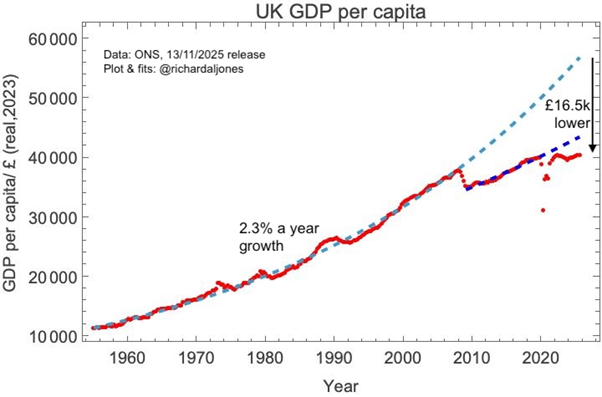
Eurgh since 2008
We’re still not building enough homes. You guessed it folks, we still aren’t building enough new homes for all ages, disastrous for the construction supply chain and a further inhibitor of growth. Savills’ excellent recent report on housebuilding (covering up to the end of Quarter 3 2025) provides a snapshot of national performance versus required output, culminating in the lovely infographic below.
Their subsequent assessment makes for mixed reading. There has been no increase in housebuilding as completions and overall consents remain flat, though this disguises a recent upswing in applications for schemes of over 100 dwellings over the past six months. Consistent concerns over lack of buying demand (which could of course be arrested by an increase in economic growth) and cost inflation persist.
Most relevant for this blog however is the future pipeline of land, gauged by whether local planning authorities have an up-to-date five year land supply through their Local Plans. One of the other 2025 planning reforms saw a change in how the Government’s assessment of housing need (the Standard Method) is calculated, increasing national targets. Authorities without an up-to-date Local Plan (i.e. less than five years old) must in most cases use the Standard Method to provide their target; at the same time, new Local Plans are expected to have housing targets that conform to the new Standard Method.
This means many authorities will face higher targets essentially by default as current Local Plans fall out of date and the changes are phased in through the new NPPF. Savills’ projection for the next two iterations of the Test shows the result: using the latest delivery figures and the new targets, the gap between the two will grow rapidly, and the number of districts failing could potentially reach over 60% by the 2024-25 Test. Let’s remember that this comes at a time when 72% of local plans are over 5 years old and 67% of authorities already do not have a 5 year housing land supply.
With the consultation NPPF emphasising the continuation of the plan-led system, a number of local authorities will have difficult decisions to make to conform to this increased requirement at a pace that will satisfy the Government (see later).
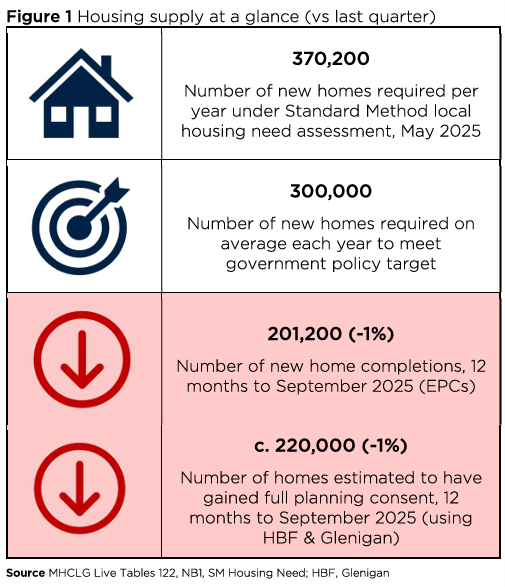
Grazie Savills
Finally, the need to decarbonise in an era of growing data consumption and reliance. The urgent need for the UK to swiftly and decisively decarbonise by 2050 was once again set out by NESO in its Future Energy Scenarios document (FES), published in November 2025.
The FES provides an independent view of a range of future pathways for the whole energy system, based on a robust and published methodology – supplemented by a rather nifty Interactive Dashboard that models all of the inputs within the FES itself against eight key themes.
As its introduction notes, the UK is now in a new energy era, with the imperative now on action rather than strategy:
The last two decades have laid the foundations for the energy transition and the remainder of this decade will see rapid acceleration, followed by growth throughout the 2030s. All this will unlock the benefits of an affordable, secure and clean energy system on the 2050 net zero horizon.
For new development, the implications are fundamental:
This means not only transforming our energy infrastructure but enabling homes and businesses to switch to low carbon energy sources for heat and transport, putting consumers at the heart of a new energy system and in control of the energy they use. Demand flexibility will play an important role here, getting more from low-cost renewable generation and helping both consumers and the energy system.
Its FES concludes that a scenario that meets “net-zero by 2050” would be the “cheapest” option for the UK. Its “holistic transition” scenario would have the lowest cost over the next 25 years, saving £36bn a year – some 1% of GDP – compared to an alternative scenario that slows climate action.
These savings are from lower fuel costs and reduced climate damages, relative to a scenario where the UK fails to meet its climate goals, specified in the FES as the “falling behind” scenario. Delivering this outcome requires significant but this would cut fossil-fuel imports (remember that most of our gas still comes from Norway!), support jobs and boost health, as well as contributing to a safer climate.
It also emphasises that slowing down these efforts would reduce the scale of investments needed, but overall costs would be higher unless the damages from worsening climate change are “ignored” (take note the ‘Institute of Economic Affairs;). Here are the two cases taken side by side within the report; small potatoes these are not, as the £bn y-axis shows.
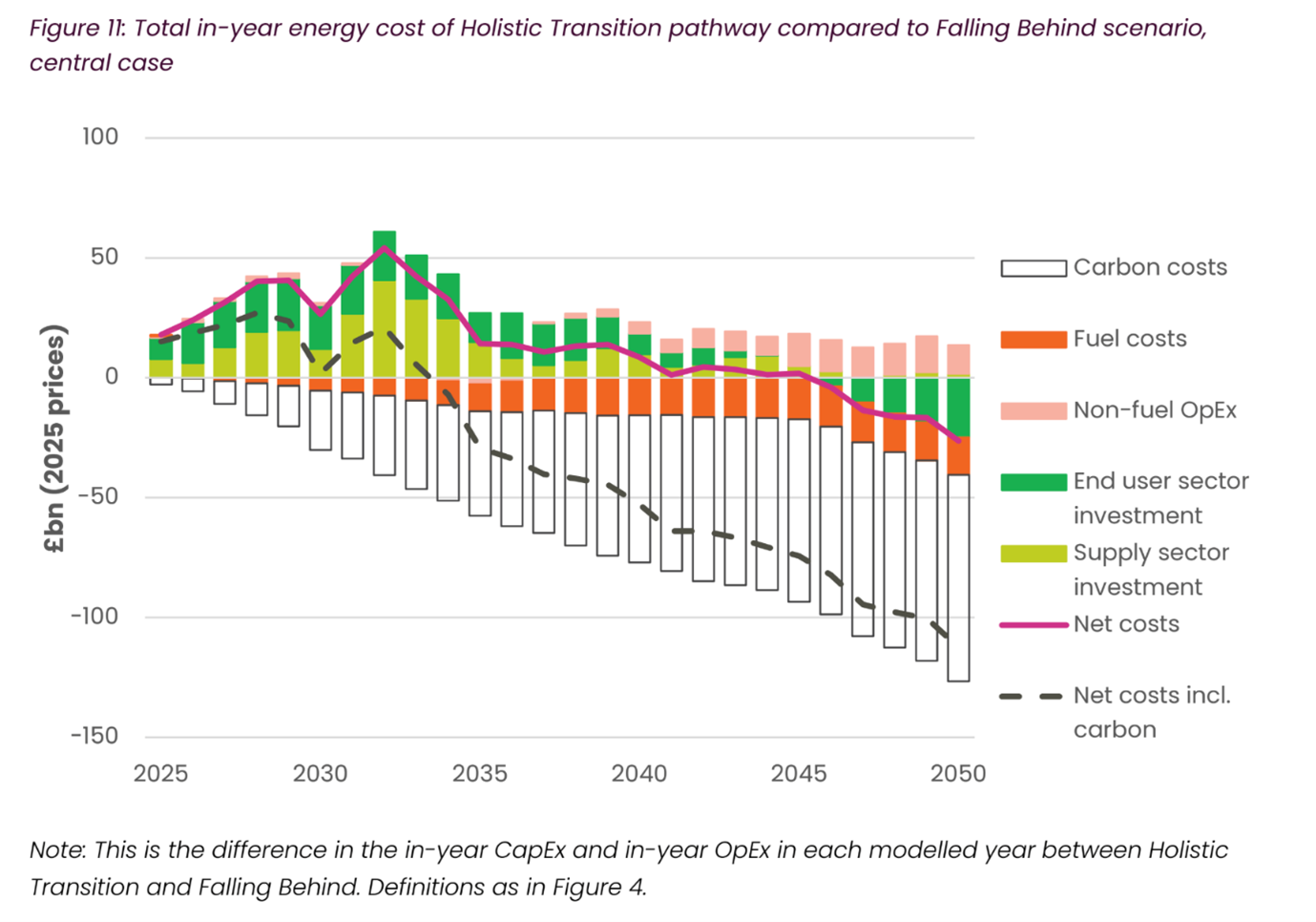
If you save any graphs from this blog, make sure it’s this one
The size of the challenge is enormous when you consider two future factors: that the UK population (currently at c. 70 million) is forecast to grow to around 78-82 million by 2050, primarily driven by net migration, whilst collectively increasing its reliance on data. The growth of data centres is inevitable given they underpin nearly all digital activity, economic growth (especially AI, finance, and tech), and public services, leading to their 2024 designation as Critical National Infrastructure (CNI). As I said on the 50 Shades of Planning podcast in the Autumn however, this growth will strain the National Grid whilst requiring significant supplies of water; remember, the UK hasn’t built a new reservoir in over thirty years!
Add all of that together, and the imperative for a simpler, clearer, rules-based planning system – and the need to properly plan key economic assets on a regional basis so they, heaven forbid, properly interrelate – is overwhelming. We therefore strongly support the thrust of the reforms.
Don’t underestimate the sheer amount of graft needed to get there though…..
Blessed are the grafters
Over the next three years, we’ll have all of this going on….
The confirmation of the revised NPPF post-consultation….
….alongside the implementation of the Planning & Infrastructure Act (2025)……
….which will directly influence the timeframe and contents of the next wave of Local Plans across England, as well as decision-taking at local planning authority level (see below)….
….and the publication of a new wave of Strategic Development Strategies within defined regional geographies (the Government wants national coverage by 2029)…..
…at a time of widespread Local Government Reorganisation.
That is a huge collective change to respond to, with an enormous amount of work falling on the shoulders of a small number of civil servants centrally and planning policy teams in local authorities.
The key thrust of this article is that the size and speed of this challenge should change how landowners and developers should promote their schemes to ensure that existing applications are approved or their future sites are formally adopted within Local Plans and Spatial Development Strategies, helping to cement a truly ‘plan-led system’.
Local Plans: the changes
Where to begin? Without doubt the two best assessments of the proposed changes in their current form sit with those remarkably consistent scribes Simon Ricketts (‘Framework Good Work’, December 2025) and Zack Simons KC (‘Planoraks 2025 – the New NPPF’) and our interpretation owes a great deal to both of their sage observations. Please read both reports if you require a detailed rundown of what the NPPF changes cover as we won’t repeat them here!
Both Simon and Zack emphasise the importance of the transition to the new arrangement which developers and land promoters must get their head around as a matter of urgency – because it is very likely indeed that the majority of the consultation NPPF will end up as the adopted NPPF.
The Government describes it here and is committed to the new NPPF coming into force in Summer 2026. The NPPF’s decision-making policies will have full effect from the day that the final version of the document is published. In simple terms:
DECISION TAKING
For applications already within the system, the new NPPF kicks off on the day it’s published in the Summer.
Until then, well… we have the old/current one….. so if you take ‘Summer’ to mean ‘21st June – 21st September’, then we have a further eight months of the old NPPF in place as the decision-taking framework for planning authorities to follow.
LOCAL PLAN MAKING
For plan-making, the new NPPF applies to new-style local plans to be produced through the new system under the Planning and Infrastructure Act. The Government has made clear that:
“Local planning authorities covered by the NPPF transitional arrangements will have to commence formal plan making (Gateway 1) by 31 October 2026, while those that have a plan that is already over five years old must commence by 30 April 2027”).
All other plans - i.e. the many local plans being progressed at the moment under the current system - they will all continue to be examined under the 2024 NPPF. These include West Lindsey in Lincolnshire and Rochford in Essex.
Never mind the volume, feel the width! So wherever your sites are in England could be subject to a different arrangement to other similar sites literally a handful of miles away ‘over the border’. But fear not….as we have some immediate advice to those with land interests regardless.
For soon-to-be-submitted applications: Get onboard with the NPPF - or properly respond to the consultation
To reemphasise: the new NPPF will be here by September at the latest; it is too important to the national economy and the Government’s programme (hopes?) not to happen. So our advice to anyone planning to submit applications in 2026 is straightforward:
Harmonise your applications with planned new arrangements as soon as possible. Getting ahead of the curve is essential; whilst the revised NPPF is both dense and complex – an entirely different beast to what we’ve seen in previous revisions – engaging properly with it will be time well spent in the first two Quarters of 2026.
If there’s anything you don’t like in the planned NPPF……then make sure you get your reps in by the 10th of March 2026 to suggest a remedy! With the number of reports, online and in-person seminars currently taking place to discuss its contents, there really is no excuse to not properly engage with its contents. Even better…..engage with the likes of the Land Property & Development Federation to make clear what changes should be to gauge if there’s a wider industry clamour for your suggestions. A collective voice always trumps individual views during a consultation period….
Promoting future schemes through new Local Plans
Now onto the herculean task of creating new Local Plans across England, of which the Government has just announced extra funding to support their production. As mentioned above, these are be split into:
‘Legacy areas’, governed under the ‘old rules’; alongside
Creating or updating a Local Plan via the new system.
As Zack’s blog asserts, once the new system has properly ‘kicked in’ (properly understood and applied National Management Development Policies; published Spatial Development Strategies – see later) then new Local Plan production should be simpler and swifter.
But let’s not kid ourselves; regardless of route, it remains a huge task for local authorities to deliver a robust local plan to meet the requirements of Government. Rotherham is one of the local authorities developing a new Local Plan under legacy rules and their production timetable reflects the sheer scope of evidence gathering, site selection, visioning, member engagement, conformity, inspection, examination and eventual adoption over the next three and a half years. This is the reality of Local Plan making in England.
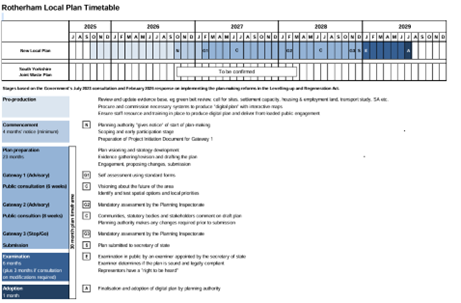
Rotherham’s new Local Plan: in development
Rotherham’s process also reflects that Policy making and the ‘call for sites’ remains at the heart of the Local Plan system. It is here where we think land promoters can do more to help create more effective local plans (and, by logic, a stronger system) within the challenging timeframes set by Government.
It would be easy for promoters in this ‘new era’ to solely rely on the contents of the NPPF alone – i.e. technical planning arguments – to attempt to secure allocations within a new Local Plan. Whilst this of course matters in a rules-based system, our strong advice is that land promoters should go further in properly explaining the merits of their proposals to support time-pressed planning policy officers – and ultimately the general public – to better understand their schemes in three key respects:
·All land promoters should get to know the whys and wherefores of the areas they want to develop in before they ever submit any representations. It sounds obvious, but over the last two decades in both public and the private sectors I’ve seen too many examples of reps being made where promoters have not got an appropriate handle on the challenges and ambitions of the areas they sit within. Whilst Nomisweb and the work of local data observatories could help fill some of the void, there really is no substitute to spending time in the areas themselves and speaking to local people. It matters.
Any promotion should always tie back to what local areas – and, where relevant, regions with Mayoral Combined Authorities – are actually setting out to achieve. Economic Strategy? Reference it. Housing Plan? Link into it. The same applies to Environmental Strategies, (regional) Strategic Growth Plans and others that have been adopted. It matters.
Finally, all of this should be done in plain language, particularly on what benefits the proposed developments will provide to local people in practice. This makes sense in two respects: it makes it easier for the local planning authority to engage with what’s being promoted; and ultimately it will set the tone for the necessary public-facing work through the planning process should an allocation be secured.
Land promoters and developers ultimately crave predictability and simplicity from the planning system. To get to a system that works better however, they also have a responsibility to walk the walk through their representations to make Local Plans as effective as possible.
The return of Strategic Planning: hurrah for those blessed with sense and foresight
As we’ve previously explained via our reports, an historic wrong has been righted with the return of Strategic Planning through the Planning & Infrastructure Act (2025).
Its importance can easily be gauged when you consider what its return entails in practice. This is how Deputy Leader of Solihull Council Ian Courts described the being-developed West Midlands SDS at the tail end of last year:
The SDS will contain a statement of policies, of “strategic” importance about land use and development; it needs to ensure collective need is met, redistributing where need cannot be met; infrastructure needs; and mitigation of climate change. Importantly it will work across administrative boundaries covering the seven metropolitan councils (Birmingham, Coventry, Dudley, Sandwell, Solihull, Walsall and Wolverhampton).
Allocation of actual housing sites is down to local councils, as are detailed policies that will help shape the development that is to take place. These will be contained within a Local Plan.
This really is big potatoes stuff in two key respects. Firstly – as that last paragraph infers - will become the guiding mind for all Local Plans in the UK. That man Zack Simons sums this up beautifully here:
What local plans become, then, is a vehicle for giving detailed and localised spatial expression to a strategy that’s already been worked out in the SDS. Not a battle-ground for arguing about housing numbers. Or the need for infrastructure. Nor indeed for arguing about detailed development management policy. A detailed map. Basically. An easily searchable list of allocations and designations. Doable in 30 months. Reviewable at most every 5 years, and maybe less.
What I’m most excited about however is the second respect: we already see the potential for SDSs, given their scope, to act as a magnet for public and private investment on schemes and programmes across myriad (planned and sequenced!) development types. This is especially relevant for the likes of Mansion House Accord signatories, including pooled local government pension funds, who are seeking opportunities to meet its terms:
Signatories to the Accord will pledge to invest 10 percent of their workplace portfolios in assets that boost the economy such as infrastructure, property and private equity by 2030. At least 5 percent of these portfolios will be ringfenced for the UK, expected to release £25 billion directly into the UK economy by 2030.
(NB. The investment side of this work is deserving of a blog in itself, and expect one here by the Spring….)
A huge effort lies ahead to make this happen. The Government wants to see full coverage of SDSs by the end of this Parliament – in theory, Summer 2029. The obvious first job, during local government reorganisation, is to make sure every part of England has a Strategic Planning Authority in place. If you’re in a Mayoral Combined Authority area, then happy days. As Catriona Riddell’s map shows below however, there’s a way to go in establishing authorities in great swathes of the South of England...
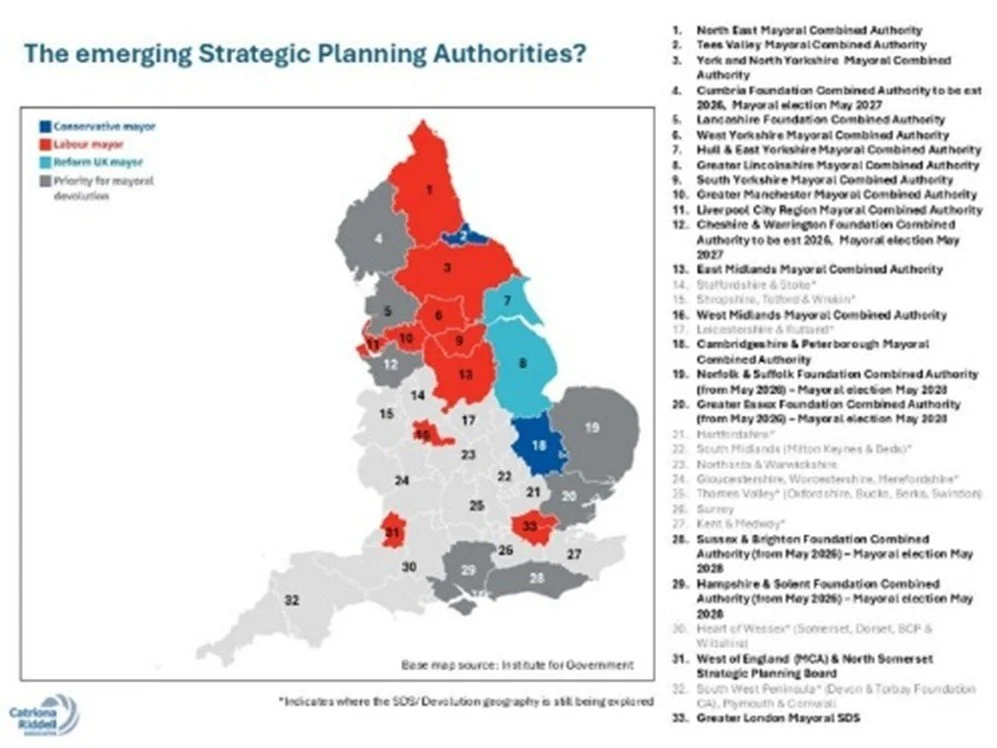
Huge thanks to Catriona as ever
Even in areas where authorities already exist, progress varies wildly. Greater Manchester – the undoubted poster child of recent strategic planning – adopted their ‘Places for Everyone’ plan in March 2024 (albeit this is a huge local plan plus SDS ‘in one’ across its nine areas). The West Midlands Combined Authority is furthest ahead of the new wave of SDS’s, reflected in the consultation it ran with residents in late 2025 based on its initial conclusions.
Most however are still at the evidence gathering stage. As this very helpful graphic from Catriona Riddell shows for the Cambridgeshire & Peterborough SDS, this is a voluminous task in itself – just look at all those inputs…..
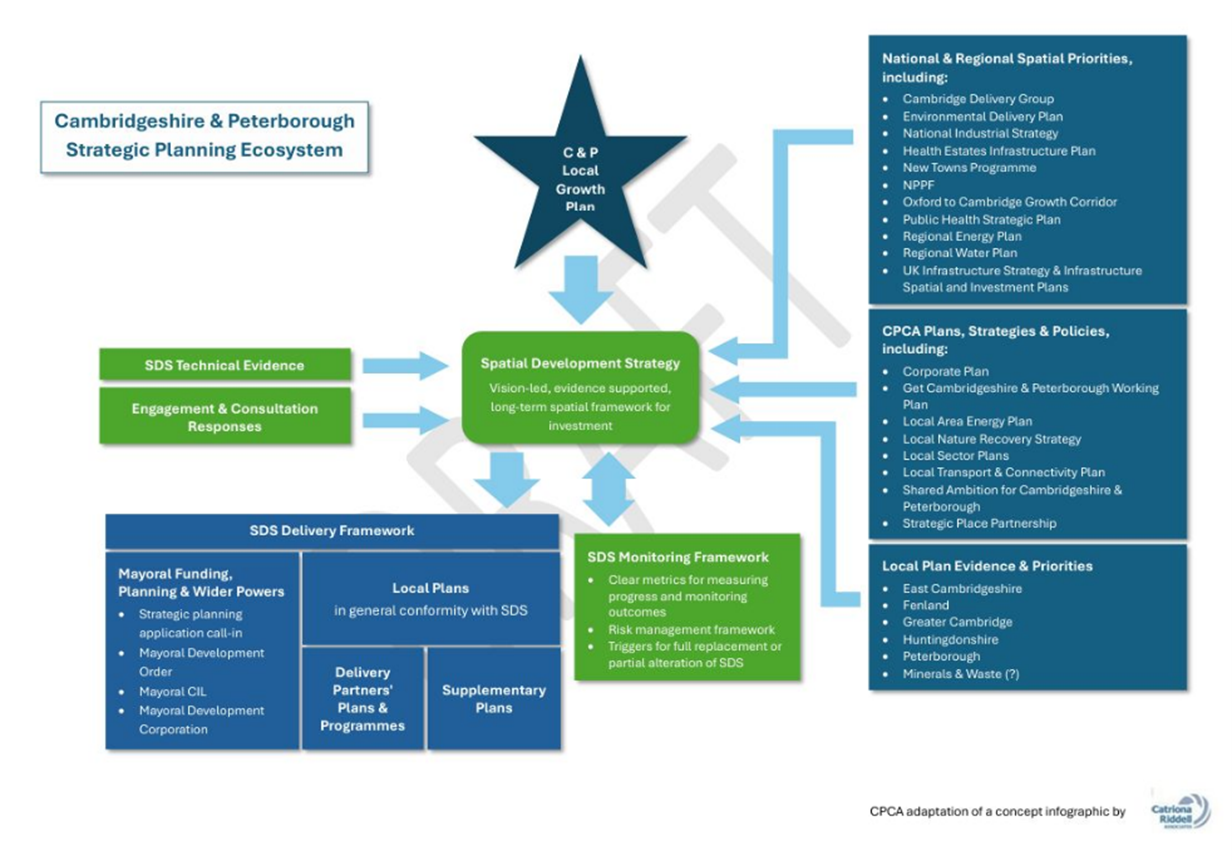
The clearest graphic we’ve seen of the SDS process
Promoting ‘strategic’ schemes through the SDS process
Like the NPPF, this change is a-coming. The sooner those with bona-fide strategic interests (sites delivering over 1000+ homes or 1m sq. ft of commercial development for instance, or those planned for key supporting infrastructure including data centres or major energy schemes) properly engage with those delivering the SDSs, the better.
Given the sheer volume of evidence that teams pulling together SDSs will need to consider in a challenging timeframe, the way that land promoters engage should follow similar principles to those of Local Plan representations. Of particular relevance is explicitly stating how those sites directly contribute to the delivery of relevant ‘Plans, Strategies and Policies’ (as Cambridgeshire & Peterborough term them) in plain language; this will save significant to-ing and fro-ing post submission.
The other key bit of course is to dedicate some proper time to the inevitable workshops, face-to-face and virtual meetings that will be created to discuss visioning, the inter-relationships between developments and schemes, the ‘future’ needs for the area, the drafting of the Plan itself and the Governance to oversee its implementation (amongst other matters). Ultimately, it is in promoters and developers best interests to make the SDS process work to create a simpler, easier to understand and more rational planning system – so they also need to put the hard yards in.
Get in touch
As ever, get in touch with us on any part of this report, including scheme promotion or in directly responding to the NPPF ahead of the 10th of March.
And finally
It wouldn’t be a Bellona report without some form of delve into the archive – in this case showing what happens when you don’t have a well-functioning planning system.
Ladies and Gentlemen, introducing the Kirkby ski slope debacle of the early to mid 1970s. It’s all here in a fantastic BBC Nationwide report from 1975: the glory of the East Lancs Road; zero regards given to planning; a deal done in a pub; construction malfeasance; literal shifting sands (and anything else in the ‘imported material’); and just one completed ski run for the princely sum of £140,000. We urge you to give it a watch.